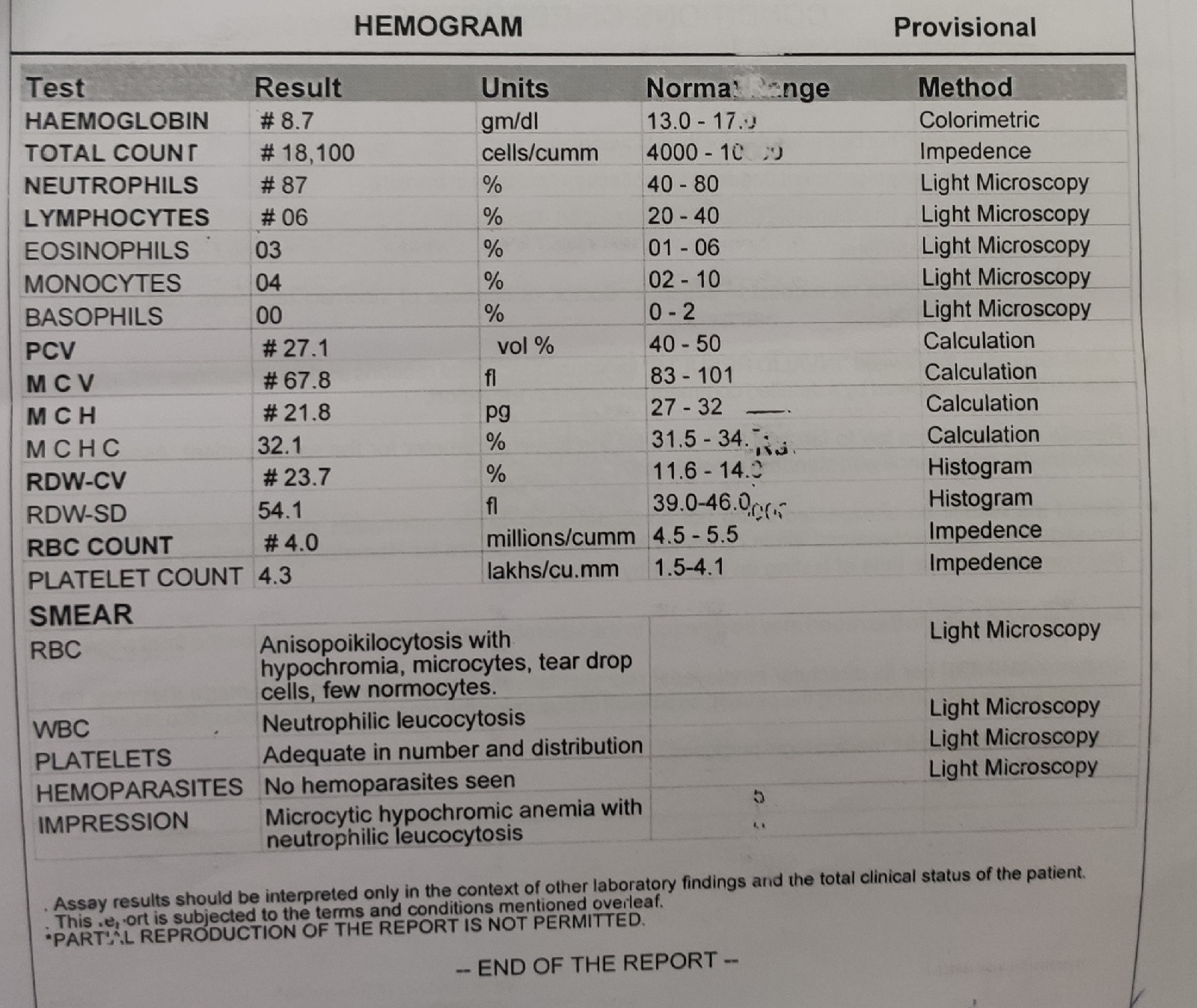
I have gone through one of my friends blog which is close to my roll number.
The case is well presented and explained. The important points were highlighted.
It was explained in coherent manner.
The symptamology are clearly listed.
Pictures are given clearly about investigation.
Complete drug history and treatment is not clearly given.
I did not get a chance to take up any case.
Please go through the cases in the links shared above and provide your critical appraisal of the captured data in terms of completeness, correctness and ability to provide useful leads to analyze the diagnostic and therapeutic uncertainties around the cases shared.
Evolution of symptoms were very well presented. Explanation for every treatment and causes were written in a very coherent manner.Overall it was very well explained and easy to understand.
CASE-2:
The history taking of the patient was written so orderly manner.It would have been better if more pictures were given directly which would make it easier to understand the context.
CASE-3:
The case was very well presented and explained.All the keywords were highlighted which made it easier to get the concept and the mechanisms of treatment and the case were very well explained.The histolgy information regarding the case made it easy to understand.
CASE-4:
It has been elaborated in very good manner. The main points have been highlighted clearly.The pictures of investigation are posted in the elog which made it easier to follow up the case.The timely updates were also mentioned.
CASE-5:
The explanation was good, but the certain points could have been highlighted. If a summary of patients details is given which made it much easier to understand.
CASE-6:
Very clean presentation and very well explained.It was easy to understand. Can add some more details about terapautic investigations.
CASE-7:
The summary of the patient was mentioned which made it easier to understand.The presentation was neat, but certain points can be elaborated.The links were attached from where the info was collected.The important words were highlited which made easier to understand the case.
CASE-8:
The patient history could have been elaborated to understand the case even more easily.The discharge summary was not given. Other than that everything is nicely presented.The scan reports were attached in orderly manner and time is mentioned regarding the investigation which is good.
CASE-9:
The patients case has been summarized it is easily understandable,the presentation was very neat and easy to understand.Main points were highlighted.The time line events were posted with progress of patient's symptoms which is very well done.
CASE-10:
The case is presented well.The time line graph of vitals had helped to understand his progress clearly.Time line of laboratory investigations is give.This made me easy to understand whether he is reacting and getting better with the the medications given to him.
CASE-11:
The case was presented well.The summary at the end was a good idea it end with.The laboratory investigations well presented in coherent manner.
QUESTION-4
Please analyze the above linked patient data by first preparing a problem list for each patient (based on the shared data) and then discuss the diagnostic and therapeutic uncertainty around solving those problems. Also include the review of literature around sensitivity and specificity of the diagnostic interventions mentioned and same around efficacy of the therapeutic interventions mentioned for each patient.
ANSWER-4
CASE-1:
Problem list:
•lower back ache
•burning micturition
•Fever with chills
•trauma to head
•mild hepatomegaly with grade 1 fatty liver
•high serum creatinine
•high blood urea
•pus cells in urine
Solution:
1)IVF : -RL @ UO+ 30ml/hr
-NS
2)SALT RESTRICTION < 2.4gm/day
3)INJ TAZAR 4.5gm IV/TID
2.25gm IV/ TID
4)INJ PANTOP 40mg IV/OD
5)INJ THIAMINE 1AMP IN 100ml NS IV/TID
6)INJ HAI S/C ACC TO SLIDING SCALE
8AM - 2PM - 8PM
7)SYP LACTULOSE 15ml PO/TID [ To maintain stools less than or equal to 2]
8) GRBS - 6th Hourly
9) BP/PR/TEMP - 4th Hourly
10) I/O - CHARTING
ON 10/7/21 :
1)IVF : -RL @ UO+ 30ml/hr
-NS
2)SALT RESTRICTION < 2.4gm/day
3)INJ TAZAR 2.25gm IV/ TID
4)INJ PANTOP 40mg IV/OD
5)INJ THIAMINE 1AMP IN 100ml NS IV/TID
6)TAB. PCM 500mg PO/ SOS
7)INJ HAI S/C ACC TO SLIDING SCALE
8AM - 2PM - 8PM
8)INFORM GRBS
9)GRBS - 6th Hourly
10) BP/PR/TEMP - 4th Hourly
11) I/O - CHARTING (STRICT)
12)T. ULTRACET PO 1/2 TAB QID
-Foley's removed,
13)INPUT UPTO 2 Liters only
CASE-2:
•lower back ache
•Dribble of urine
•Pedal edema
•High blood urea
•High serum creatinine
•Anemia
•Spondylodiscitis
•Tremours
Solution:
13/7/21
• IVF - NS-0.9% @100ml/hr
• Inj. Tazar 2.25gm I.V -TID
• Inj. Lasik 40mg I.V -BD
•Nebulization Salbutamol -4th hourly
• Inj. Pantop 40mg I.V -OD
• Tab. PCM 650mg -TID
• Foleys catheterization
• Temperature ,Bp, PR Charting hourly
• Strict IO Charting
•GRBS -12th hourly
• Inj.25% D with 10units of insulin IV -slow for 1hr
14/7/21
• IVF -NS 0.9% & DNS -continous infusion @100ml/hr
• Inj.Piptaz 2.25gm I.V -TID
• Inj.Lasix 40mg I.V -BD
• Inj.Pantop 40mg I.V -OD
• Nebulization budecort -8th hourly
• T.PCM 650mg -TID
• INJ. Neomol 1mg -I.V -SOS
• Temperature charting 4th hourly
• Monitor Bp,PR
• Left U/l elevation
• strict I/O charting
• Nebulization Salbutamol 2 repluses -6th hourly
• INJ. MAI 10u in 25% D over 45min I.V
15/7/21
• IVF -NS 0.9% &DNS U.O + 30ml/hr
• Inj. PIPTAZ 2.25gm -I.V -TID
• Inj.Lasix 40mg I.V -BD
• Inj.Pantop 40mg I.V -OD
• Nebulization Salbutamol 2 repluses -6th hourly
• T.PCM 650mg TID-after checking Temp.
• Temperature charting 4th hourly
• Monitor Bp,PR
• strict I/O charting
• Syp. Mucaine gel 10ml -BD
16/7/21
• IVF -NS 0.9% &DNS U.O + 30ml/hr
• Inj. PIPTAZ 2.25gm -I.V -TID
• Inj.Lasix 40mg I.V -BD
• Oral fluids upto 2-3liters/day
• Monitor Bp,PR ,Temperature
• strict I/O charting
• Limb elevation- Crepe bandage
• Syp.mucaine gel 15ml -TID
17/7/21
• Inj. PIPTAZ 2.25gm -I.V -TID
• Inj.Pantop 40mg I.V -OD
• Syp.mucaine gel 15ml -TID
• Limb elevation- Crepe bandage
• Monitor Bp,PR ,Temperature ,spo2%
• Tab.Febuxostat 40mg -OD
• Inj.Optinueron 1 ampule in 100ml NS /I.V/ OD
18/7/21
• Inj. PIPTAZ 2.25gm -I.V -TID
• Inj.Pantop 40mg I.V -OD
• Inj.Optinueron 1 ampule in 100ml NS /I.V/ OD
• Syp.mucaine gel 15ml -TID
• Limb elevation- Crepe bandage
• Monitor Bp,PR ,Temperature ,spo2%
• Tab.Febuxostat 40mg -OD
• Oral fluids upto 2-3L/day
19/7/21
• Inj. PIPTAZ 2.25gm -I.V -TID
• Inj.Pantop 40mg I.V -OD
• Inj.Optinueron 1 ampule in 100ml NS /I.V/ OD
• Syp.mucaine gel 15ml -TID
• Limb elevation- Crepe bandage
• Monitor Bp,PR ,Temperature ,spo2%
• Tab.Febuxostat 40mg -OD
• Oral fluids upto 2-3L/day
20/7/21
• Tab.Pantop 40mg -OD
• Tab.Febuxostat 80mg -OD
• Tab.Neurobion forte -OD
• Syp.mucaine gel 15ml -TID
• Limb elevation- Crepe bandage
• Monitor Bp,PR ,Temperature ,spo2
• Oral fluids upto 2-3L/day
21/7/21
• Tab.Pantop 40mg -OD
• Tab.Febuxostat 80mg -OD
• Tab.Neurobion forte -OD
• Syp.mucaine gel 15ml -TID
• Limb elevation- Crepe bandage
• Monitor Bp,PR ,Temperature ,spo2
• Oral fluids upto 2-3L/day
• Inj.Ciprofloxacin 500mg-OD
22/7/21
• Inj. Ciprofloxacin 500mg-OD
• Tab.Febuxostat 40mg -OD
• Tab.Neurobion forte -OD
• Tab.pantop 40mg-OD
• Syp.mucaine gel 15ml -TID
• Limb elevation- Crepe bandage
• Monitor Bp,PR ,Temperature ,spo2
• Oral fluids upto 2-3L/day
•Tab.Ultracet 1/2 tab.-QID
CASE-3:-
Problem list:
•Haemorrhoids
•Muscle aches
•Fever
•Generalized weekness
•Vomiting
•Pedal oedema
•Dimorphic anaemia
•High serum creatinine
•High blood urea
•Multiple myeloma
Solution:-
on 9/07/2021
- T. PAN 40mg /PO / OD
- oral fluids upto 1.5 - 2 lit / day
- Protein - x ( plant based ) 2 tablespoon in 1 glass of milk
- Donot give IV fluids unless instructed
- T. ZOFER 4mg / PO / SOS
- Evaluate Anaemia start Iron Supplementation (oral ) after Gastritis ( (resolved )
- TAB NODOSIS 550 BD
10/07/2021
- oral fluids upto 1.5 - 2 lit / day
- T. PAN 40mg /PO / OD
- T. ZOFER 4mg / PO /SOS
- TAB NODOSIS 550 mg / PO/BD
- Protein - x ( plant based ) 2 tablespoon in 1 glass of milk
- I/O charting
- BP / PR / Temp - 4th Hrly
- Neb c Duoun 2 respules 8th hrly
★11/7/2021
- oral fluids upto 1.5 - 2 lit / day
- Tab PAN-D PO/OD ( 8AM)
- T. ZOFER 4mg / PO /SOS
- TAB NODOSIS 550 mg / PO/BD
- Protein - x ( plant based ) 2 tablespoon in 1 glass of milk
- Inj ERYTHROPOIETIN 4000IVS/C weekly twice
- BP / PR / Temp - 4th Hrly
- T. OROFER - XT PO/BD
- Inj OPTINEORON 1 AMO IN 500ml NS IV/OD
- IVF -NS UO +30ml/hr
- RL
- I/O - CHARTING
★12/7/21
-inj.optineuron 1 amp in 500ml NS IV/OD
-ivf. NS RL @ uo + 30 ml/hr
-inj. erytropoitin 4000 iv s/c weekly twice
-tab.pan-d po/od (8 am)
-tab.orofer-xt PO/BD
-tab.nodosis 500mg PO/BD
-protein- x powder 2 tsp in 1 glass of milk PO/TID
-tab. zofer 4mg PO/sos
-BP/PR/Temp - 4th hrly
- I/o - charting
★13/7/2021
- Inj.optineuron 1 amp in 500ml NS SLOW/ IV/OD
-tab. pantop 40 mg RO/OD
-tab.nodosis 500mg PO/BD
-Protein- x powder 2 tsp in 1 glass of milk PO/TID
-I/o charting
- T.OROFER XT/OD
14/07/2021
- Inj.optineuron 1 amp in 500ml NS SLOW/ IV/OD
-tab. pantop 40 mg RO/OD
-tab.nodosis 500mg PO/BD
-Protein- x powder 2 tsp in 1 glass of milk PO/TID
-I/o charting
- T.OROFER XT/OD
CASE-4:-
•Problem list:
•Fever
•Diarrhea
•Back pain
•Diabetes mellitus type 2
•Vomiting
•Loose stools
•Metabolic acidosis
•Bed sores
•Left kidney increase in size
•Acute polynephritis
Solution:-
Ventilator
Dialysis
Physiotherapy
Treatment for sores
Day 1
Inj. NORAD 2amp in 50ml NS
Inj. PIPTAZ 2.25gm.
Inj. DOPAMINE 2amp in 50ml
Inj. HAI 1ml in 39ml NS
Day 2
Inj.HAI 1ml in 39mlNS
Inj. PIPTAZ 2.25gm.
Inj. CLEXANE 40gm.
Iv infusion NS RL @100ml/hr.
Day 3
Inj.HAI 1ml + 34ml NS
Inj. PIPTAZ 2.25gm
Iv infusion NS (urine output + 40ml/hr)
Inj. NORADRENALINE(2 amp+46ml NS)
Day 4,5 same as day 3
Day 6
Inj. PIPTAZ
Inj. LEVOFLOX
Inj. VANCOMYCIN
Day 7 and 8 same as day 6.
Day 9
Inj. MEROPENEM
Inj. LEVOFLOX
Inj.VANCOMYCIN
Day 10 and 11 same as day 9
Day 12
Inj. MEROPENEM
Inj. FOSFOMYCIN
Inj. CLEXANE
Day 13 and day 14 same treatment as of day 12 additionally Inj. LASIX was given.
CASE-5:-
Problem list:-
•Diabetes mellitus type 2
•Hepatic encephalopathy grade2
•Abdominal distension
•Pedal edema grade 2
•Pus cells in urine
•Anemia
•Abnormal increase in urea in urine
•Increase in levels of alakaline phosphate
•Multiple acute infarcts in bilateral cerbral and Cerebellar hemispheres
Solution:-
Day 1:
1. Inj. Monocef 1gm IV/BD
2. Inj. Vancomycin 500mg IV/BD in 100ml NS over 1hr
3. Procto clysis enema
4. Inj. Pan 40 mg Iv/OD
5. Inj. Thiamine 200mg in 100ml NS /BD
6. Inj. HAI 6U S/C TID
Day 2&3:
Same treatment followed
Day 4:
Same treatment followed except Inj. Monocef.
Inj. Augmentin 1.2 gm IV/TID
Tab. Ecospirn 150mg PO/HS/SOS
Tab. Clopidogrel 75mg PO/HS/SOS
Tab. Atorvas 20mg PO/HS/OD added
Advice at Discharge:
1. Inj. Vancomycin 500mg IV/BD in 100ml NS over 1hr
2. Inj. Pan 40 mg Iv/OD
3. Inj. Thiamine 200mg in 100ml NS /BD
4. Inj. HAI 6U S/C TID
5. Inj. Augmentin 1.2 gm IV/TID
6. Tab. Ecospirn 150mg PO/HS/SOS
7. Tab. Clopidogrel 75mg PO/HS/SOS
8. Tab. Atorvas 20mg PO/HS/OD added
CASE-6:-
Problem list:-
•Fever
•Pus in Urine
•Prostomegaly
•Hypnoatremia
•High creatinine levels
•High grade fever with chills and rigor
•Anemia
•Bilateral hydroureteronephrosis more on right
•Urinary bladder with diffuse circumferential wall thickness
•Phlebolith
Solution:-
Injection PANTOP 40mg IV/OD
Injection PIPTAZ 4.5 stat and 2.25 gm IV/ TID
Injection LASIX 40mg IV/BD
Injection optineuron 1AMP in 100ml NS slow IV/OD
Injection NEDMOL 100ml IV/SOS
Tab PCM 650mg TID
Insulin Human actrapid - 16 IU/TID
CASE-7:-
Problem list:-
•Shortness of breath
•Deranged RFT
•Chronic renal failure
•Orthopnea
•Diabetes mellitus type 2
•Hypertension
•Edema
•Hemoglobin level less
Solution:-
1. TAB. BISOPROLOL 5mg OD
2.TAB. NITROHART 20/37.5mg 1/2 T/D
3.TAB NICARDIA XL 30mg OD
4.TAB. GLICIAZIDE 80mg BD
5.TAB. NODOSIS 500 mg TD
6.Cap. BIO-D3 OD
7.Cap. GEMSOLINE OD
8.TAB. ECOSPRIN-AV 150/20mg OD
9.TAB.LASIX 40mg BD
10. SYP. LACTULOSE 15ml
CASE-8:-
Problem list:-
•Pedal edema
•Loose stools
•Vomitings
•Pneumonitis with time 1
•Grade 1 fatty liver
•Increased serum creatinine
•Increased blood urea
•Right heart failure
Solution:-
1. IV fluids
2. Tab. Pan 40 mg po OD
3. Inj. Lasix 80 mg IV BD
4. Thiamin 200 mg in 100 ml NS IV BD
5.Tab. Levocet 5 mg Po BD
6.Liquid paraffin for LIA
7.Grbs 6 th hrly
8.I/o charting, temp.charting
CASE-9:-
Problem list:-
•Loose stools
•Abdominal distension
•Pedal edema
•Alcoholic hepatitis
Solution:-
- INJ THIAMINE 100 mg in 100 ml NS slow IV / TID
- INJ OPTINEURON 1AMP in 100 ml NS slow IV / OD
- INJ LASIX 40 mg
- TAB. ALDACTONE 50 mg PO / BD
- INJ PANTOP 40 mg IV/ OD
- ABDOMINAL GIRTH MEASUREMENT DAILY
- BP /PR/TEMP/ RR -4 hourly
- I/O CHARTHING
On 06/07/2021 :
1)PLENTY OF ORAL FLUIDS
2)INJ.METROGYL 400mg /IV/TID
3)INJ .CIPROFLOX 500mg /IV//OD
4)INJ.PANTOP 40mg iv/OD
5)INJ.THIAMINE 1amp in 100ml NS IV/TID
6)INJ.OPTINEURON 1ampin 100ml NS IV/od
7)TAB .SPORLAC DS PO/TID
8)ORS SACHET 1 in 1L OF WATER
9)TAB LOPERAMIDE. 2mg /po / SOS
10)BP/PR/TEMP/ RR 4 th hrly
11)I/O CHARTING.
On 07/07/2021 :
- PLENTY OF ORAL FLUIDS
- INJ.METROGYL 400mg /IV/TID
- INJ .CIPROFLOX 500mg /IV//OD
- INJ.PANTOP 40mg iv/OD
- INJ.THIAMINE 1amp in 100ml NS IV/TID
- INJ.OPTINEURON 1ampin 100ml NS IV/od
- TAB .SPORLAC DS PO/TID
- ORS SACHET 1 in 1L OF WATER
- TAB LOPERAMIDE. 2mg /po / Sos
- BP/PR/TEMP/ RR 4 th hrly
- I/O CHARTING.
On 08/07/2021
1)PLENTY OF ORAL FLUIDS
2)INJ.METROGYL 400mg /IV/TID
3)INJ .CIPROFLOX 500mg /IV//OD
4)INJ.PANTOP 40mg iv/OD
5)INJ.THIAMINE 1amp in 100ml NS IV/TID
6)INJ.OPTINEURON 1ampin 100ml NS IV/od
7)TAB .SPORLAC DS PO/TID
8)ORS SACHET 1 in 1L OF WATER
9)TAB LOPERAMIDE. 2mg /po / SOS
10)BP/PR/TEMP/ RR 4 th hrly
11)I/O CHARTING.
*12)TAB ECOSPIRIN 75mg/po/od
On 09/07/2021 :
1)PLENTY OF ORAL FLUIDS
2)INJ.METROGYL 400mg /IV/TID
3)INJ .CIPROFLOX 500mg /IV//OD
4)INJ.PANTOP 40mg iv/OD
5)INJ.THIAMINE 1amp in 100ml NS IV/TID
6)INJ.OPTINEURON 1ampin 100ml NS IV/od
*7)TAB LORAZEPAM 2mg OD
8)ORS SACHET 1 in 1L OF WATER
*9)TAB ECOSPORIN 75 mg OD
10)BP/PR/TEMP/ RR 4 th hrly
11)I/O CHARTING.
On 10/07/2021 :
1)PLENTY OF ORAL FLUIDS
2)TAB PANTOP 40mg iv/OD
3)INJ.THIAMINE 1amp in 100ml NS IV/TID
4)INJ.OPTINEURON 1ampin 100ml NS IV/od
5)TAB ECOSPORIN 75 mg OD
6)TAB LORAZEPAM 2mg OD
7)BP/PR/TEMP/ RR 4 th hrly
8)I/O CHARTING
On 11/07/2021 :
1)PLENTY OF ORAL FLUIDS
2)TAB PANTOP 40mg iv/OD
3)INJ.THIAMINE 1amp in 100ml NS IV/TID
*4)TAB NEUROBION FORTE OD
5)TAB ECOSPORIN 75 mg OD
6)TAB LORAZEPAM 2mg OD
6)BP/PR/TEMP/ RR 4 th hrly
7)I/O CHARTING.
On 12/07/2021
1)FLUID RESTRICTION <1.5L/ day
SALT RESTRICTION <2gm/day
2)Tab PAN 40mg iv/OD
*3)TAB. BENFOMETPLUS OD
*4)TAB NEUROBION FORTE OD
5)TAB ECOSPORIN 75 mg OD
*6)TAB LIVOGEN OD
*7)INJ. VITCOFOL 500mg IM/OD
*8)TAB. LASIX 20mg OD
*9)TAB. RIFAXIMINE 550mg BD
6)BP/PR/TEMP/ RR 4 th hrly
7)I/O CHARTING.
CASE-10:-
Problem list:-
•Pedal edema pitting type
•Fever
•Diabetes mellitus
•Acute kidney injury secondary to urosepsis
•Shortness of breath
•Increased serum creatinine
•Increased blood urea
•Hemoglobin lower than normal
Solution:-
- Inj LASIX 40mg (8am- 2pm -8pm)
- IVF - NS @ UO + 50 ml/hr
16/6/21- Inj LASIX 40 mg IV/TID 1 -1 - 1
- IVF - NS @ UO + 50 ml/hr
- Inj MAGNEXFORTE 1.5 gm/IV/BD
- Tab NODOSIS - XT PO/OD
- Inj HAI s/c
- Neb plain Asthalin 4 respules [ 1 - 1 - 1 - 1 ]
17/6/21- Inj LASIX 40 mg IV/TID 1 -1 - 1
- IVF - NS @ UO + 50 ml/hr
- Inj MAGNEXFORTE 1.5 gm/IV/BD
- Tab NODOSIS - XT PO/OD
- Tab OROFEA - XT PO/OD
- Inj HAI s/c
- Neb plain Asthalin 2 respules
- Strict I/O charting
18/6/21- Inj LASIX 40 mg IV/TID 1 -1 - 1
- IVF - NS @ UO + 50 ml/hr
- Inj MAGNEXFORTE 1.5 gm/IV/BD
- Tab NODOSIS - XT PO/OD
- Tab OROFEA - XT PO/OD
- Inj HAI s/c
- Neb plain Asthalin 2 respules QID
- Strict I/O charting
- Tab ULTRACET 1/2 tab QID [ 1/2 - 1/2 - 1/2 - 1/2 ]
19/6/21
- Inj LASIX 40 mg IV/TID 1 -1 - 1
- IVF - NS @ UO + 50 ml/hr
- Inj MAGNEXFORTE 1.5 gm/IV/BD
- Tab NODOSIS - 500 mg PO/OD
- Tab OROFEA - XT PO/OD
- Inj HAI s/c
- Neb plain Asthalin 2 respules QID
- Strict I/O charting
- Tab ULTRACET 1/2 tab QID[ 1/2 - 1/2 - 1/2 - 1/2 ]
20/6/21
- Inj LASIX 40 mg IV/TID [ 1 -1 - 1 ]
- IVF - NS @ UO + 50 ml/hr
- Inj MAGNEXFORTE 1.5 gm/IV/BD
- Tab NODOSIS - 500 mg PO/OD
- Tab OROFEA - XT PO/OD
- Inj HAI s/c
- Neb plain Asthalin 2 respules QID
- Strict I/O charting
- Tab ULTRACET 1/2 tab QID[ 1/2 - 1/2 - 1/2 - 1/2 ]
- BP/PR/SO2/Temperature monitoring
- GRBS charting
21/6/21
- Inj LASIX 40 mg IV/TID [ 1 -1 - 1 ]
- IVF - NS @ UO + 50 ml/hr
- Inj MAGNEXFORTE 1.5 gm/IV/BD
- Tab NODOSIS - 500 mg PO/OD
- Tab OROFEA - XT PO/OD
- Inj HAI s/c TID [ 10U - 8U - 8U ]
- Neb plain Asthalin 2 respules QID
- Tab Norflox 200 mg PO/BD
- Tab ULTRACET 1/2 tab QID[ 1/2 - 1/2 - 1/2 - 1/2 ]
- BP/PR/SO2/Temperature monitoring
- GRBS charting
- Strict I/O charting
22/6/21
- Inj LASIX 40 mg IV/TID [ 1 -1 - 1 ]
- IVF - NS @ UO + 50 ml/hr
- Tab Norflox 200 mg PO/BD
- Ing OPTINEURON 1amp in 100 ml NS IV/OD
- Tab OROFEA - XT PO/OD
- Tab SHELCAL-CT PO/OD
- Inj HAI s/c TID [ 10U - 8U - 8U ]
- Tab ULTRACET 1/2 tab QID[ 1/2 - 1/2 - 1/2 - 1/2 ]
- BP/PR/SO2/Temperature monitoring
- GRBS charting
- Strict I/O charting
23/6/21
- Inj LASIX 40 mg IV/TID [ 1 -1 - 1 ]
- Tab Norflox 200 mg PO/BD
- Tab ULTRACET 1/2 tab QID[ 1/2 - 1/2 - 1/2 - 1/2 ]
- Tab OROFEA - XT PO/OD
- Tab SHELCAL-CT PO/OD
- Inj HAI s/c TID [ 10U - 8U - 8U ]
- BP/PR/SO2/Temperature monitoring
- GRBS charting
- Strict I/O charting
CASE-11:-
Problem list:-
•pain in abdomen in epigastric redion
•Vomiting
•Increased serum creatinine levels
•Pedal edema pitting type
•Distended abdomen
•Tremors
•Acute pancreatitis
Solution:-
Dialysis is done to correct serum creatinine levels and urea levels
Iv fluids : NS 40 ml /hr.
IV lasix 40 mg BD .
Tab Nodosis .
IV PIPTAZ 4.5 Gms. BD
Iv 25%Dextrose. 100 ml BD
Tab . Nicardia 10 mg TID.
D A Y W I S E U P D A T E S:
Day 1and 2 =Urine output 1500ml,
Fluid intake 3000ml
QUESTION-5
Reflective logging of one's own experiences is a vital tool toward competency development in medical education and research.
ANSWER-5
In the midst of the pandemic medical school taking the online approach which is primarily a practical sector. This is the educational set up where doctors interact with the patients and try to gather history and knowledge and try to provide their expertise. But still our medical schools are working and they have brought the clinical rotation for which we had always as a medical student being excited about right in front of our mobile/laptop screens. The general medicine faculty have been doing great and also are helping us to acquire knowledge and helped us learn to use the Internet and motivate us to read research papers and old cases about a topic. This has been a great learning session for all of us , looking forward to attend the clinical postings in the hospital.